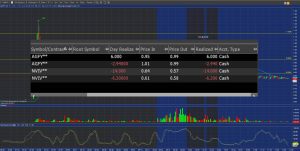
Today’s live trading session covered four positions I took as part of my trading day, where not everything went according to plan. This trading session highlights that not every trading day needs to end in profit. It’s crucial, especially on days when we experience losses, to ensure those losses are controlled.
I entered four positions across three stock symbols, primarily using a dip buying strategy off of the morning highs. Unfortunately, none of the anticipated moves fully materialised, but I was quick to cut my losses. My losses averaged around 6 cents, and I was pleased with how I managed the risks.
As I’ve mentioned before, not every day in day trading will be profitable. The objective is to ensure that on days when you incur losses, those losses don’t devastate your trading account. Essentially, you want to live to trade another day.
Trade 1: YTEN at Market Open
At the market open, my attention was captured by YTEN. The stock had already surged by a hundred percent with significant volume in the first few minutes.

I marked some key support and resistance lines from the daily chart. As the price neared the 0.49 area, I saw a potential for it to climb back to .54, the morning high. Hoping for the price to surpass the morning high and reach new highs, possibly up to $1, I took a position just above the $.50 mark. When the price showed strength around the $.52 mark, I bought in at $.52 per share.

I scaled into my position, ending up with 300 shares at an average price of $.52, hoping for a breakthrough past the .54 mark. However, an indecisive doji candle formed on the 5-minute chart, and the price began showing signs of exhaustion. Observing weakness around the $.52 mark, I decided to exit at $.51. Fortunately, my exit was timely as the price then dropped to as low as 47 cents within a few minutes. I was content with my exit strategy.
Trade 2: ADVM
My second trade of the day involved ADVM. The stock had risen by about 35 to 40% on the day, trading in the 1.90-1.92 region.
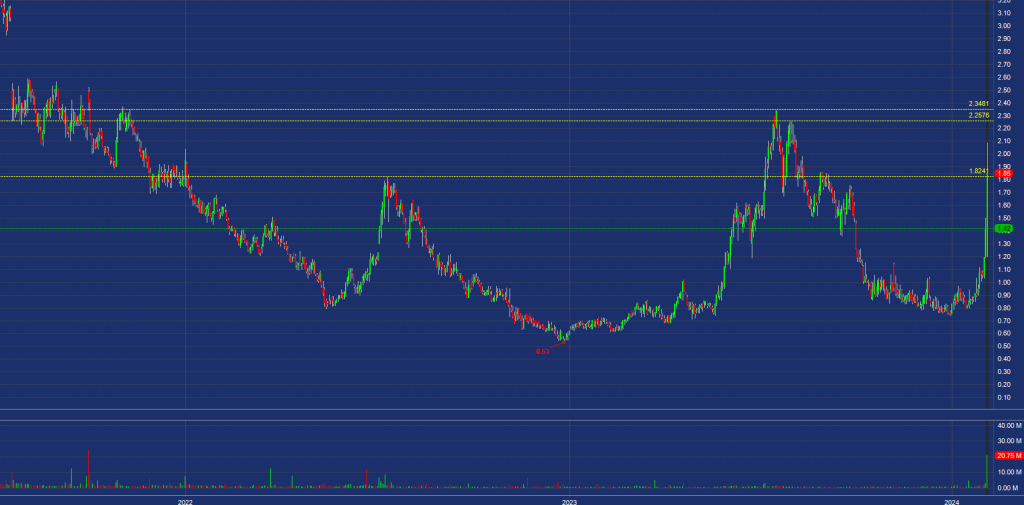
After quickly reviewing the daily chart and identifying key support and resistance levels from previous high-volume days, I noticed a resistance line around the 1.84 mark and another at 2.27 from eight months back.
As ADVM had hit a day high of $2.09 that morning and pulled back to the 1.90 region, I looked for a confirmed bounce on the one-minute chart to take a position.

As the price found support at 1.86, I took a position at 1.88 but didn’t get filled, so I entered at 1.91 for 100 shares, aiming for the $2 mark and beyond. However, the price began showing signs of weakness, leading me to exit the trade at 1.85, avoiding a larger potential loss.
Trade 3: YTEN Again
My third trade was once again with YTEN. After exiting my earlier position at $0.51 per share with a slight loss, I re-entered at $.49, hoping for a push beyond $.50 and to test the day’s high at $.56 per share.

The price, however, started to show signs of weakness, leading me to close my position at $.48, resulting in a minimal loss. The price continued to decline, validating my decision to exit early.
My Fourth Trade: BRTX
For my final trade of the day, I turned my attention to BRTX, a stock I had been keeping an eye on since morning.

I started by looking at the daily chart, where I identified a significant area around the $2.90 mark. This level had seen multiple lows over the past year. Additionally, I noticed a day with particularly high trading volume that opened at around $3.70. Observing the price’s interaction with the 50-period moving average on the 1-minute chart suggested it might be a good time to consider an entry.

When the price began to cross over the 50-minute moving average, finding some stability between $2.90 and $3.00, I decided to take my position at $3.05. Unfortunately, this trade, much like my previous ones for the day, didn’t unfold as hoped. The price action on the 1-minute chart soon turned unconvincing, moving sideways before breaking below the near-term support of $3.00. I had been optimistic about the price potentially testing the $3.20 and then $3.34 levels, but as it fell below $3, I chose to exit at $2.94. Entering at $3.05 and exiting at $2.94 meant I faced a loss of 11 cents per share.
Summary and Learnings
Today’s trading session, though not profitable, was rich in lessons and reminded me the importance of disciplined risk management and strategic exits. The day ended with a total loss of $18 plus commission fees, with an average loss of $4.5 per trade. Despite the setbacks, I am content with my decision-making process, particularly how I managed to limit losses by responding promptly to the market’s signals. Below are two key learning points from today’s trades:
Learning Point 1: Importance of Timely Exits and Recognising Signs of Weakness
One of the most critical lessons for me from today’s session is the importance of recognising early signs of weakness in the one-minute charts and acting swiftly. Holding onto a position in hopes of a recovery often leads to greater losses. Today’s trades taught me that exiting a trade at the first sign of weakness could prevent significant drawdowns. This approach is crucial for preserving capital and ensuring that a bad trade does not escalate into a worse one. The ability to minimise losses, even when the market moves against your initial hypothesis, is a vital skill in day trading, as demonstrated by the early exits from YTEN and ADVM positions.
Learning Point 2: Evaluating Entry Points and Resistance Levels in Dip Buying
Another valuable insight from today’s trading is the evaluation of entry points and resistance levels when employing a dip buying strategy. The anticipation of a stock bouncing back to morning highs requires a prior analysis of support and resistance levels. However, it’s also important to observe the stock’s behaviour around these levels closely. If a stock does not decisively break through immediate resistance levels after finding support, it may indicate a lack of strength for a significant rebound. This observation was particularly relevant in the trades with YTEN and BRTX, where the stocks failed to push through immediately critical resistance points on the 1 min chart, prompting an early exit. This strategy not only helps in minimising losses but also in refining the criteria for selecting entry points for potential high-reward trades.
Conclusion
The day’s trading, although not yielding profits, provided invaluable insights into the mechanics of risk management and the nuanced pitfalls of day trading. These learnings will serve as a foundation for me for future trades, emphasising the necessity of disciplined exits and the strategic evaluation of entry points based on market behaviour. By remembering these lessons, traders can enhance their ability to navigate the volatile day trading environment, ultimately leading to improved decision-making and risk management in day trading sessions.